


Dŵr Cymru responded to our challenge
Eben Myrddin Muse
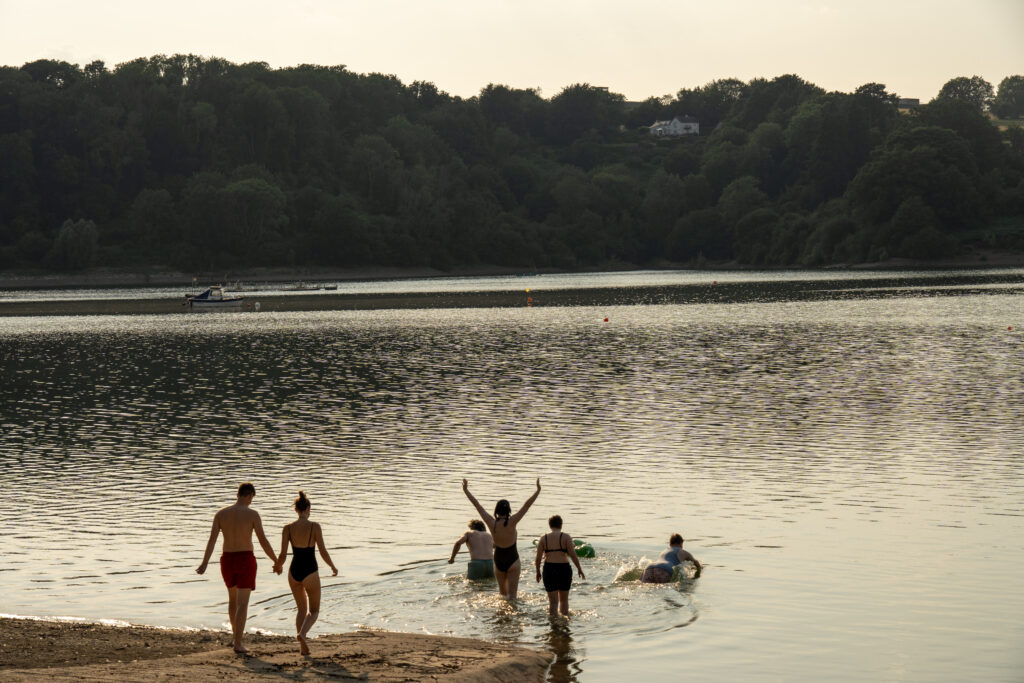
Recently I published a piece about how I believed that Dŵr Cymru (Welsh Water) engage in a form of corporate gaslighting and an abdication of their social responsibility when it comes to open water swimming. A small group of us also trespassed in our local Dŵr Cymru reservoir at Llanishen in protest at the way they throttle access and sustain financial in the very few places they swimming at all.
It is to their credit that they responded to our concerns. Dŵr Cymru’s Chief Strategy and Stakeholder Engagement Officer Alun Shurmer penned an article; Reservoir safety is not about restricting enjoyment: it is about recognising risk. The most common response to the article was speculation that it was written by ChatGPT – whether that’s true or not I can’t say, but the fact that it is seen as formulaic and inauthentic in this way speaks volumes about how their words have been received.
I also don’t believe that any of my points were sufficiently addressed. Instead, it misrepresents the conversation we are trying to have; they frame it around their own question of “whether unsupervised swimming in working reservoirs can be treated as if it carries the same risk as swimming in a natural lake or a managed bathing area”. But this was never the matter of contention.
There is no lack of recognition of the unique risks of reservoir swimming among those calling for a rethink on access to water – in fact, the opposite is true. We feel that the problems are serious enough that they deserve action and that current policies are insufficient. Recognition isn’t enough and it never was. Anybody who’s ever written a risk assessment knows that what matters is what you do about risk – the precautionary and preventive measures. A few signs people ignore doesn’t cut the mustard.
The article leans on our prohibitive access laws like a crutch. They say that access to water is permissive – they say it is not a right, and therefore they’re under no obligation to provide it. This is true, but while they claim that the permissive nature of access to Water “is not a barrier invented by Dŵr Cymru; it is the current legal framework” the truth is that it is a barrier propped up by Dŵr Cymru. One they could easily remove. Other barriers – financial ones – are entirely of their design.
Scottish access law, is described as ‘not absolute’. But that’s irrelevant; we don’t seek “absolute” – we seek reasonable, responsible, safe, access to the waters of Wales; exactly what Scottish law happens to provide, and precisely what we deserve in Wales.
Dŵr Cymru say that Scottish landowners “manage or restrict access where safety, operational or environmental risks require it”, with the implication being that it’s ‘not so different up there’. But here’s a reality check: it is very different. Scottish Water do not (cannot) prevent access anywhere on their entire estate, except for two sites where there are byelaws in place. That’s two reservoirs out of around 300 they manage, which is fewer than than 1% of the total. Oh, for a future where Dŵr Cymru “manage or restrict” access in the manner of their Scottish colleagues.
There is a section of the article which is particularly important that activists address – a reference to the death of and quote from the mother of teenager Reuben Morgan, who died at Pontsticill Reservoir near Merthyr Tudful in 2006. A quote from Reuben’s mother is included. It’s impossible to comprehend what she went through at that time, and has gone through in all of the years since – the loss of a person so young at a time of celebration is a cruel thing from which one never recovers. She has my utmost compassion, and respect for how she has used her personal loss to save the lives of others. His school friends have been equally strident in the years since.
But for the purposes of this conversation an important fact is that Reuben’s loss did not occur at a reservoir where swimming is allowed, facilitated, or managed. He died trying to swim across a reservoir which was, and is, palisaded with signs telling him that he must stay out of the water. It was a tragic event that was and is a function of the failed prohibitive system that we are campaigning against, and that Dŵr Cymru wishes to sustain. I can’t know if a different approach to managing water safety in Wales – an approach grounded in management, provision, and education – would have saved his life that day. But I can say with certainty that the current approach of blanket prohibition did not. And it continues to fail to save others.
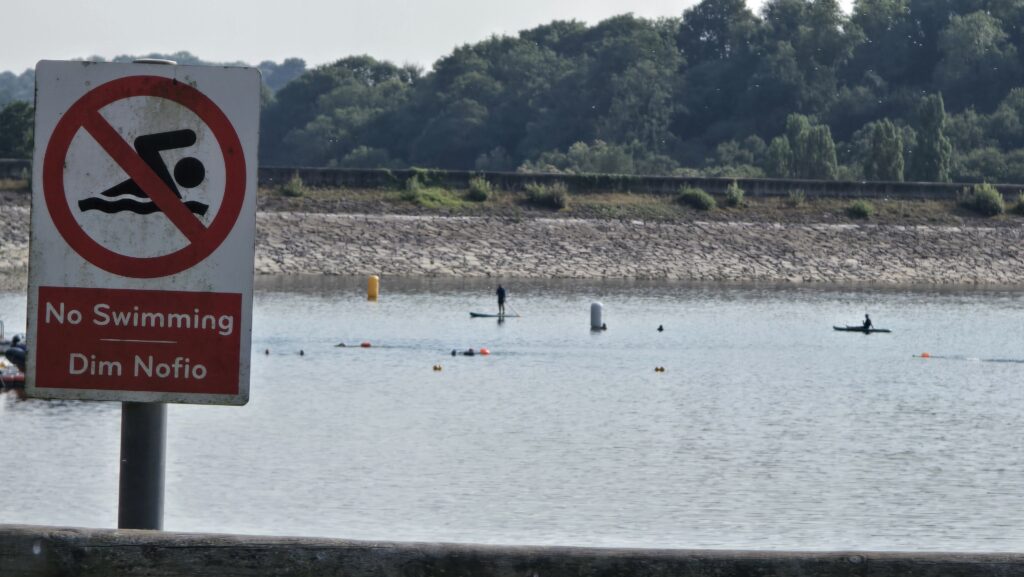
Activists and swimmers across Wales aren’t blind to the risks of open water swimming, especially in reservoirs. We want to be informed of risks. What we expect of Dŵr Cymru is a policy that understands that recognising risks isn’t the same thing as doing something about them. One that doesn’t see signs and hostile, deceptive Facebook posts, is the end of their responsibility to people like Reuben, and the thousands of people, who have entered Dŵr Cymru Reservoirs in his wake. I think it’s rather perverse to hold up an example of a death on Dŵr Cymru’s watch to try and somehow justify the fact that they “make no apology for putting safety first”. I think an apology is way overdue.
A Facebook post last week repeated the Dŵr Cymru mantra that ‘Unauthorised Access’ is dangerous. But this is a lie – or at least a twisting of the truth. It’s not non-authorisation that leads to death in Wales’ Waters. It’s a lack of willingness to engage with real hazards because organisations like Dŵr Cymru feel like these facebook posts are enough. The fact the post also prohibits the use of inflatables (which could, theoretically, be used as flotation aids in an emergency), adds to this impression. I suppose we should be grateful that they’re not following the act of English water companies who are using the heatwave as an excuse to close permissive footpaths on their estates.
The article closes with a statement that “the risk is real, and because the consequences of getting it wrong can be devastating”. The risk is indeed real. But the fact that many hundreds of people are (according to Dŵr Cymru’s own data) swimming in their reservoirs ignorant of the details of hazards we are told are present every sunny day shows that Dŵr Cymru are already getting it very wrong.
Since responding to my article, Dŵr Cymru have presented the Welsh public with a sort of catch-22 where we can either pay the highest bills anywhere, or continue to expect terrible service, left vulnerable residents without water in a heatwave, all while flushing Welsh ecosystems with human excrement in the middle of a heatwave. So, not a good start.
A few days ago, I joined a group on another water-trespass protest, this time at Llandegfedd reservoir – built in the 1960s, partly based on the promise of accessible outdoor recreation for local children, now the site of disputes over overcharging and under-delivering where locals bemoan the ‘running into the ground’ of the site’s leisure provisions. It is another of Dŵr Cymru’s reservoirs where they have assessed that swimming is safe enough to allow – as long as it is on their narrow terms and is paid for in advance.
Llandegfedd is also interesting because its 434 acres and 5,300,000,000 gallons of water are mostly sourced from the river Usk – a river which many would love to swim in, but dare not due to the awareness of how polluted it is (swage was dumped in it 1,313 times last yaer). Indeed, as I type, sewage flows freely into the river from the storm overflow drain in Brecon. Needless to say, it is not currently raining anywhere in Wales right now and has not for some time.
Meanwhile at Llandegfedd the water was inviting – on arrival, a group of locals warned us not to get too close to the reservoir wall as we’d be shouted at by ‘blue canoe’, a reference to the wardens who were patrolling the paid open water swimming session currently taking place between the big yellow buoys. Athletic-looking swimmers splashed back and forth.
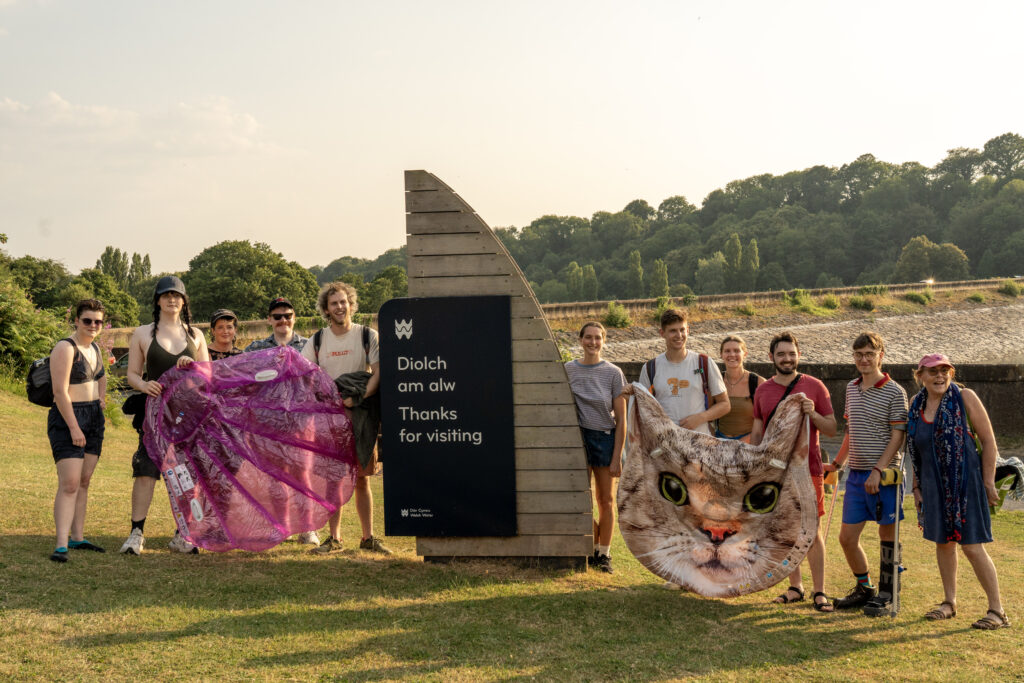
I got to chatting with a few of the wetsuit-clad individuals, who mostly seemed to regret the choice of swimwear in the heat (except one, who feared that he would sink without it). One expressed frustration at what he saw as a deliberate policy to limit public access to the water by reducing the time available for swimming, so that people couldn’t make it in time after work. I told him of our plans to try and sneak in down the way. He laughed and said we should go for it. Our group, a little bigger this time, now included members of a recently-formed group aiming to test water quality in the river Taf.
It turned out that the blowing of big pink inflatables is not something you can do stealthily – but in the end, we made it into the water near the watersports centre, along an easy gangway where the water depth drops off gradually. This time our stay would not be long – two staff members clocked us and emerged hastily, one striding off toward the visitor centre to fetch security.
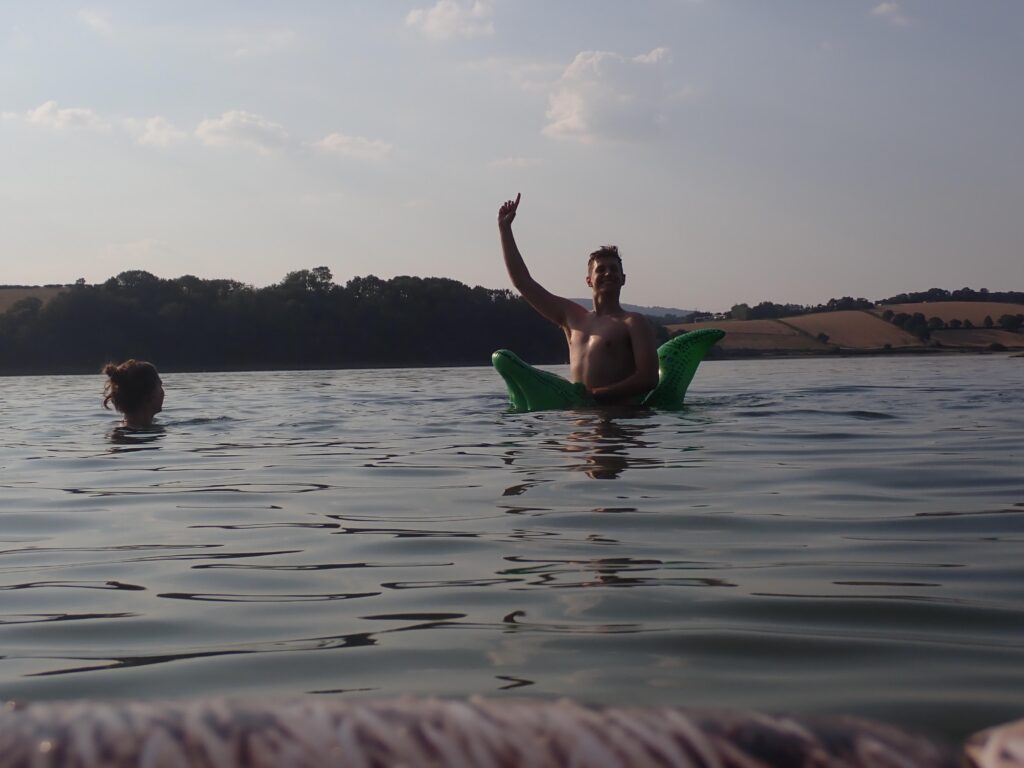
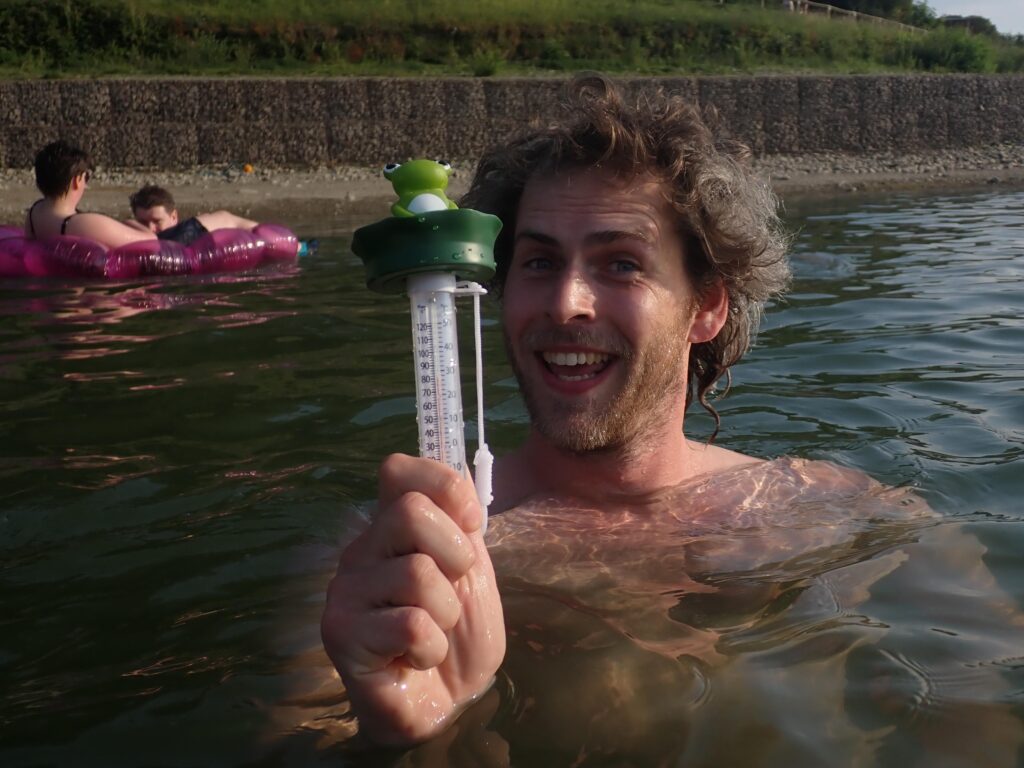
My thermometer showed a balmy 27 degrees, about 12 degrees to warm for cold water shock but still about seven degrees cooler than the surrounding air. After about ten minutes, a man in a neon jacket was gesturing at us that we needed to leave.
“You can’t swim, there are no lifeguards!”
“Aren’t you a lifeguard?”
“Yes, but we’re trying to leave!”
Fair enough – point made, we made for shore to towel off. The security guard – who clearly deals with incidents like this all the time – seemed pleased that we gave little in the way of resistance. “Only following orders” he joked, in a mock German accent. “Auf wiedersehen!”
He described a recent encounter with a group of boys who were not so obliging, leading to confrontation; “They tried to be cheeky.”
As we left, a member of our group approached a staff member and asked when they “Turn the turbines on” since much is made of the danger to the public of being sucked into such hazards.
The response of “Well I’m not going to tell you that now, am I?” represents a peculiar (less is more when it comes to information available to the public it seems) approach to safety. It is worth noting that unlike other ‘public’ bodies and utilities, Dŵr Cymru are not subject to Freedom of Information rules that might otherwise force them to disclose it.
As we swam in Llandegfedd, many others swam unlawfully in other places across Wales, notably at Cosmeston Lakes in Penarth. Swimming in Cosmeston is not new – “hundreds” swam there when the quarry was first retired and flooded. The Council restricts access to the lake, they say due to – “Cold water shock, hidden hazards and strong currents can quickly turn serious”. But why would there be underwater currents there? And what information is available about these hazards?
Water quality monitoring shared with me via an FOI shows that the water quality is consistently very high, with bacterial thresholds ‘excellent’. Later tests undertaken by Aqua Park group showed the same pattern. It is therefore a rare body of water anywhere in Wales where swimmers can be confident that they will not catch a debilitating bacterial illness (a real hazard, as children swimming in Aberdulais falls discovered earlier this summer) caused by a Dŵr Cymru outflow. A 2025 survey commissioned by the Council in 2025 showed that the danger from the ubiquitous ‘hidden hazards’ was, in fact, a fiction; “a professional scuba diving team has surveyed the lakebed where the Aqua Park is located, in conjunction with a bathymetric depth survey, to confirm that there are no objects under the surface.”
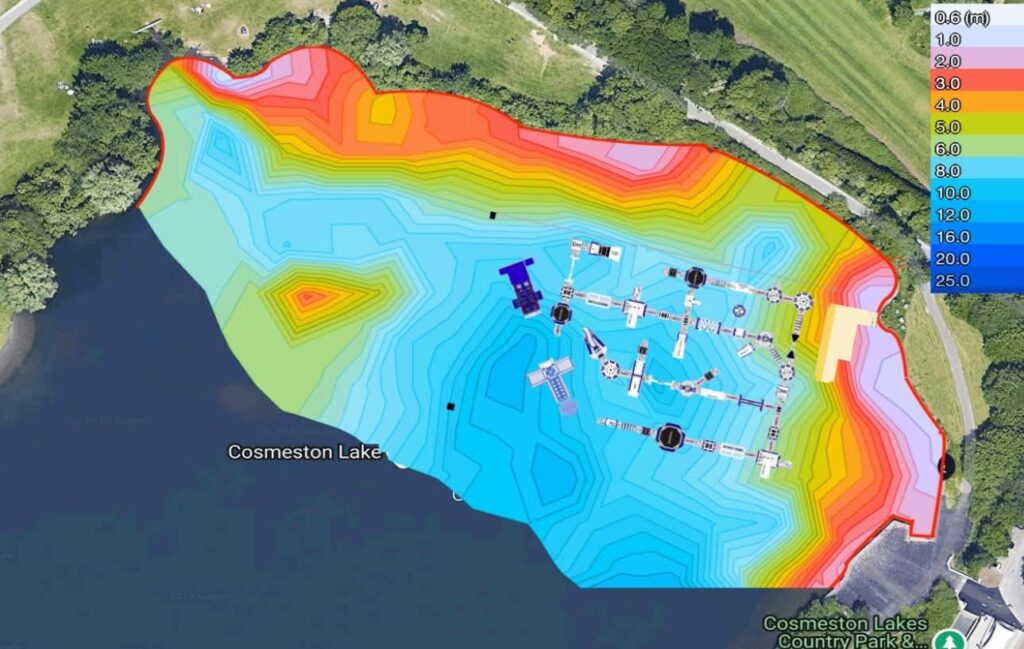
As protests mounted against the short-lived Aqua-Park that was set up there (after moving from Cardiff Bay, the Council could not identify any inherent physical features of the eastern lake (where the park is, and where people swim); “We restrict open public swimming on site as there are no safety measures in place to protect members of the public i.e. lifeguards, first aid station etc”. Well. Put them there!
There has been no attempt to provide for public safety for swimmers (unless you pay to bounce around and subsequently fall in) – luckily Glamorgan Council were caught with their pants down when a company came knocking with bags of cash; allowances can clearly be made. Claims that swimming cannot be allowed due to wildlife hold no water when you commission an aquatic assault course during the most critical time of year for nesting birds. The council simply cannot have their cake and eat it and the debacle has led to dozens dismissing the council’s advice altogether with huge crowds gathering to swim. If a huge commercial operation trading all day, every day, for months is no problem, it’s fair to ask why a few mums, grannies, and teenagers bobbing around in the shallows in a heatwave is a disaster that merits calling the police?
These are management choices. Bad ones. The same choices Dŵr Cymru makes in swerving their responsibility. If, heaven forbid, someone gets into trouble and gets hurt in Cosmeston or in reservoirs across Wales, it will be a product of those choices. A byelaw in place in Cosmeston leaves room for the Council to do things differently without a change in the law – “No person shall bathe in any waterway comprised in the land except in an area where a notice exhibited by the Council permits bathing.” The same ability rests in the hands of Dŵr Cymru who have the capability to allow and manage access in spite of the law. It is not a shield. It is not an acceptable excuse.
In the meantime, the best tool for communities such as those attempting to exercise a right to swim that doesn’t yet exist is to follow in the footsteps of the people of Hay on Wye and force the hand of Government and regulators – apply for bathing water status. Get your councillors and Senedd Members involved in the fight.
Welsh communities do not hold many tools to improve water quality or public access. At the Warren, they showed that bathing water status is a tool that can force accountability and secure public access. There are currently only four inland bathing spots – as temperatures rise, so must that number. For our health, and the health of our inland waters, for public health, and for all the natural life they support.
Support our Nation today
For the price of a cup of coffee a month you can help us create an independent, not-for-profit, national news service for the people of Wales, by the people of Wales.
Get more trusted Welsh news
Choose Nation.Cymru as a preferred source in Google News to see more of our journalism.



I remember swimming in Cosmeston back in the 1980s and there was never any problem. Good to know there’s no underwater hazards though lol.
Thank you for your research on Cosmeston. I’ve always wanted to swim there but never felt safe. Screw the council, let them try and stop me now.
Disgraceful to use the death of someone who died under their watch on their reservoir as an excuse to not do better now.
My days of swimming in Ardudwy’s high lakes, even colder then, are over but after reading of the absolute criminality of their fellow Aquarians in England the culpability of their Welsh counterparts in Dwr Cymru is on my mind as I read…
Setting a bad exampl for kids with this. There is old crane machinery in cosmeston, I remember it being there when they flooded it. Don’t think the divera removed it did they?
How deep is the water in this flooded quarry ?
I am a former DCWW employee and specifically work in the dams and reservoirs field and I can tell you that what DCWW are doing is a load of bull. Yes SOME reservoirs have dangerous risks, in SOME areas of the reservoir. But these can easily be mitigated by allowing bathing only in the safer areas of the reservoir and with warning systems in place. They are clearly trying to avoid any bad publicity for events that are not their fault and outside of their control. No one is asking them to have lifeguards on duty every 50m around all… Read more »
Thanks for sharing that. If you ever want an off-the-record conversation about this please send me a message on Instagram or Bluesky!